When you think about visiting an art gallery you might imagine being serious, and reverent in a space. However the new show at the Immigration Museum in Melbourne aims to make you grin, giggle and even dance!
On view until 7 December ‘Joy’ is an exhibition putting happiness centre stage with a presentation of work by leading Victoria-based creatives. In their own way each artist sparks joy, as the gallery says ‘big joyous moments and more reflective spaces capture all kinds of joy, from the carefree years of childhood to a celebration of belonging and togetherness.’

Elyas Alavi is an Afghanistan Australian visual artist and poet who has created ‘In Search of the Simurgh’ with Sher Ali. The work is intended celebrate the resilience and strength of immigrants and refugees as well as impart the idea that with community you can face challenges and experience joy. The optimistic message takes shape as a large-scale mural and neon text, illustrating the story of the Simurgh, a Persian mythical bird (which has parallels to the story of a rising Phoenix). Also inspired by nature ‘Our Laughter Will Become the Waterfall’ by Wiradjuri artist and poet Jazz Money is a painted mural crafted to reference the ‘laughing waters’ of the Birrarung Marr and express the joyousness of being on country.
Nadia Hernández shares ‘Que te puedo decir, así son las cosas’ (or, What can I say, that is how things are) a work which celebrates everyday moments, or ‘cotidianidad’, like a good tune or some great grub! Her aesthetic is bold and bright with a tableau of cut-out-like shapes that seemingly groove across our field of vision, enticing us to enjoy a moment of joy – just as her work is inspired by everyday pleasures.

Riffing on good vibes and nostalgia Callum Preston’s piece ‘Video Land’ replicates the experience of wandering though a video store in the 1990s. He invites you to bask in the memory of hunting down your Friday-night movie and ‘play shop’, as the designer and artist says it’s an experience ‘I never thought I would miss until I realised it was gone.’ He sourced the videos from all around Australia, it’s special to imagine that all these VHS tapes (discontinued now for 20 years) have had past lives and brought joy to individuals. It is also an opportunity to introduce the younger generations to a world before the instant gratification of streaming content.
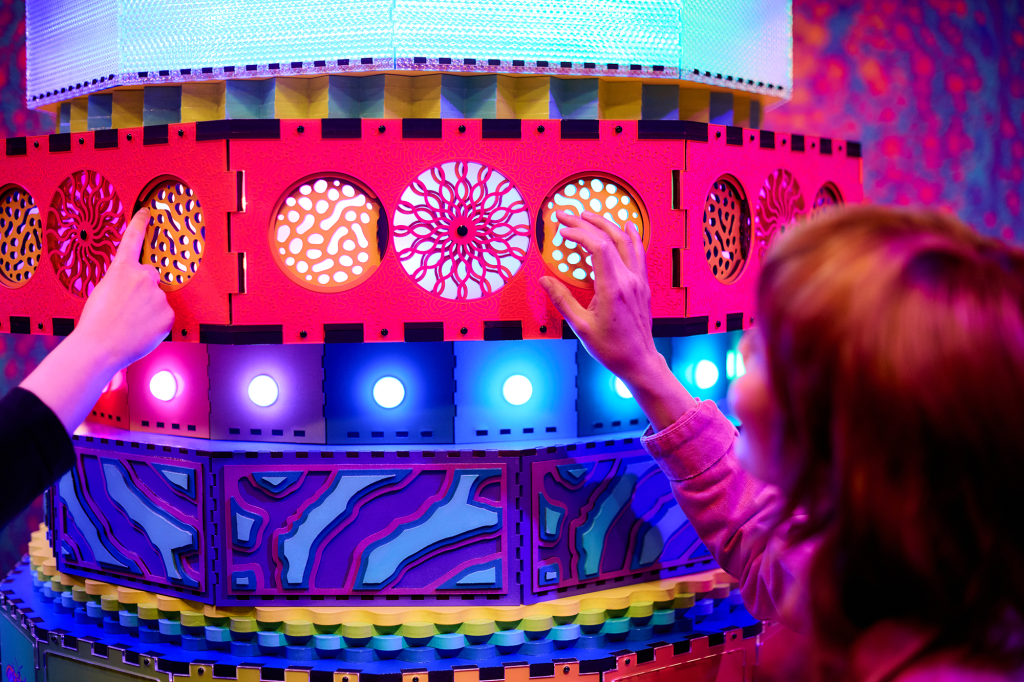
Tapping into an alternate reality artist and fashion designer Nixi Killick (self described ‘imagineer’) presents ‘Joy Generator’ a totem-shaped machine which they describe as a ‘pillar of positivity’. It gives off light, colour and has nine augmented reality targets you can interact with using your phone which are emblematic of transformation and positive change; a real vibe!

Bunny Dearest by Beci Orpin is an ode to childhood and is in part inspired by the rarity of being surprised by something, having a random belly laugh, or an unexpected guffaw as we get older. It meditates on the power of joy, how it’s not only for the young. Flipping the script on how one would ‘usually’ interact with an artwork, audiences are invited to sit on, climb or chill out on the enormous plush Bunny Dearest sculptural installation.
Reiterating the idea that joy is for all, Spencer Harrison’s work ‘Bring it to the Runway, Runway’ manifests as a colourful and inclusive runway, inviting you to come and strut your stuff under a canopy of colourful Perspex jewels and upbeat playlist. Harrison’s intervention in the space is intended to celebrate all identities, inspired by memories of growing up as a young queer person who loved performances and drag.
The artists collectively demonstrate the power of joy and the role art can play in helping us to tap into it. The show ‘Joy’ is also an example that there are myriad ways to reach the destination of a positive experience or moment of happiness. Finally the array of unique artists, who all have different practices and personal histories, model that joy is accessible to us all.